Steve Eisman on the AI boom, recession risk and investing for everyone
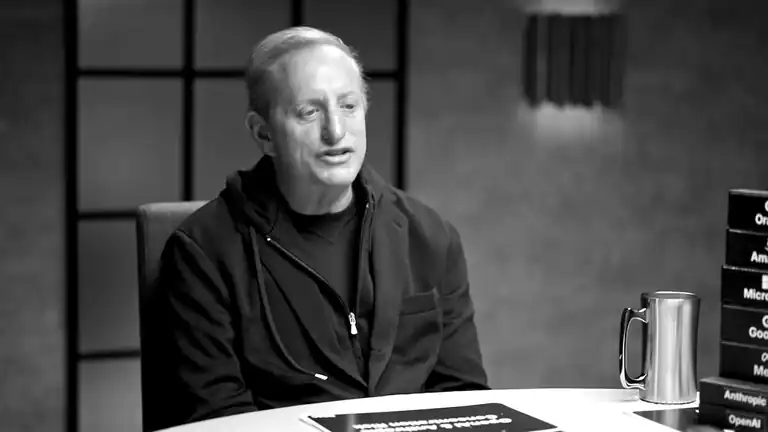
Is the AI boom a bubble, and what would happen to ordinary people if it burst? Steve Eisman, the investor whose bet against the subprime mortgage market features in Michael Lewis's book The Big Short, explains how the 2008 crash grew out of incentives, why he sees the dot-com era as the closer parallel for AI, and why he argues that much of the US stock market and economy now leans on two AI companies, Anthropic and OpenAI. He gives his reasons for doubting warnings that AI could end the world, shares his plain advice for everyday investors on index funds, crypto, gold and buying a home, and talks about the loss of his son and a short letter from his wife, Valerie.
Key ideas
The moments worth jumping to. Tap a time to watch that part of the conversation.
Why incentives trump ethics
Eisman recalls a 2007 dinner in Las Vegas with a manager of CDOs, bonds built from subprime mortgages, and explains what he worked out afterwards: lenders, banks and managers were all paid on volume, so lending standards kept loosening while the losses only showed up later. From it he took a rule he says he thinks about all the time, that incentives trump ethics every time. He then explains his own trade in plain terms: a credit default swap works like insurance on a bond, and he bought it on subprime securitisations without needing to own them (09:26).
13:58The dot-com lesson for AI
Eisman argues that the dot-com bubble holds a more useful lesson for today than the 2008 crisis. He says the sentences people use about AI are the same ones he heard about the internet, and describes how a mania led to heavy overinvestment in young companies with little revenue, most of which went bankrupt. A second generation, such as Google, went on to thrive using infrastructure that had already been built. He adds that the dot-com crash was mostly a tech recession that ordinary consumers barely felt.
20:38Why the AI boom depends on two companies
Eisman walks through what he calls concentration risk. In his account, Nvidia relies on a handful of large cloud customers, and those cloud businesses earn much of their AI revenue from Anthropic and OpenAI, whose commitments drive orders for chips and data centres. He estimates that around 65% of the S&P 500 is now exposed to AI (25:51), and says that if both companies went bankrupt the US would go into recession, while stressing that this is a big if and that he is not predicting it (28:54).
30:21How the midterms changed his view
Eisman says the midterm elections changed his outlook, because decisions about where data centres can be built are made town by town and state by state (33:33). He expects construction to slow, and argues that a moderate slowdown could be healthier, letting the largest tech companies spend less each year and rely less on the bond markets. He also says data centres have become unpopular across the country, and that the technology industry has done a poor job of explaining their benefits (52:54).
43:28A debate about AI safety warnings
Eisman argues that warnings that AI could end the world are an attempt to invite regulation that would keep cheaper Chinese models out of the US. Steven challenges him, citing the safety experts he speaks to, public statements from AI leaders and a set of safety commitments that AI company leaders signed with President Trump. Asked how he could be wrong, Eisman says it would take artificial general intelligence being much closer than he believes, and adds that he judges the companies by what they do, pointing to their plans to go public (49:25).
59:19His advice for everyday investors
Eisman's advice for most people is to avoid picking stocks, buy an S&P 500 index fund, keep adding to it whenever they can afford to and leave it alone for decades. He says he would never buy crypto because, in his view, it rises and falls with tech stocks, the opposite of how a hedge should behave (1:00:26), and he argues that in the US today renting and investing the difference can make more sense than buying a home (1:09:02).
1:24:23How grief changed him
Eisman talks about the death of his son Max, 24 days after he was born in 1996, and says he never looked at the world as safe again. He describes years of anger that he links to his part in the financial crisis, the therapy that helped him and his wife Valerie, and a line about grief that matched his experience: for a long time it is the first thing you think about each morning, until one day it is the second. Near the end comes a short letter from Valerie (1:30:34).
Chapters
Every chapter in the episode, each linking to that point in the video.
00:00Intro02:10Are We in an AI Bubble Right Now?04:03The Vegas Dinner That Exposed the Subprime Mortgage Scam09:26How Steve Eisman's Big Short Bet Actually Worked13:58Why the Dot-Com Bubble Is the Real Lesson for AI16:55Are AI Companies Really Making Money?20:38Why the AI Boom Depends on Just Two Companies25:51How Much of the Stock Market Is Now Tied to AI?28:54What Happens if Anthropic and OpenAI Go Bankrupt?30:21How the Midterms Changed Steve Eisman's AI Prediction33:33Why Big Tech Can't Just Build Data Centers Anywhere39:29Ads41:33Why AI Companies Have No Moat43:28Is the AI Doomsday Warning a Conspiracy?49:25Could Steve Eisman Be Wrong About AI?52:54Why Data Centers Are So Unpopular Across America55:03Will AI Really Wipe Out Jobs?57:31What Is Steve Eisman Investing in Right Now?59:19What Should You Do With a Small Sum Today?1:00:26Why Steve Eisman Will Never Buy Crypto or Gold1:04:03Is the US Deficit Going to Cause a Crisis?1:06:38Ads1:09:02Should You Buy a House Right Now?1:12:05Steve Eisman's Rules for Being a Better Investor1:13:44Why Steve Eisman Won't Touch CoreWeave or Tesla1:15:41If You Could Only Own One Stock, Which Would It Be?1:16:55Should You Invest in the Anthropic and OpenAI IPOs?1:20:11Steve Eisman's Advice for Young People Starting Out1:24:23How Losing His Son Changed Steve Eisman's Life1:30:34A Letter From His Wife Valerie
About the guest
Steve Eisman is an American investor known for betting against the subprime mortgage market before the 2008 financial crisis, while at the hedge fund firm FrontPoint Partners. His part in the story is told in Michael Lewis's best-selling book The Big Short (The New York Times, 8 June 2011). The episode description says he now hosts a financial podcast and educational venture with his wife, Valerie, which aims to help everyday people understand the markets.
In the episode he says he trained in law and worked as a corporate lawyer, which made him miserable, until a day of aptitude tests showed that his strength lay in generating ideas and that detail was his weakness. He moved to Wall Street and worked at Oppenheimer, where the internet analyst Henry Blodget sat across the hall. He says the anger Steve Carell shows in the film of The Big Short is how he really was at the time, and that today the business he runs is basically him and his wife.
Questions about this episode
Short answers, with sources, to questions people ask about this conversation and about the show.
Is there a fact-check for this episode?
This episode was fact-checked. A research document was not published for it. The views and claims in the conversation are Steve Eisman's own. Nothing in the episode is investment advice.
Did Steven challenge any of Steve Eisman’s views?
Yes, on the warnings about AI (43:28). Steven tells him that he speaks with safety experts who have worked on the problem for 15 years, reads out the safety commitments that AI company leaders signed with President Trump (45:13), and puts it to him that a company that stopped could hand first place to a rival, or that China might win (51:11). Eisman replies that he does not trust the companies’ leaders and judges them by what they do.
About the show
Does Steven Bartlett agree with his guests?
Not necessarily. In a statement in January 2026, the show’s spokesperson described The Diary Of A CEO as a long-form, conversational podcast that explores guests’ perspectives in their own words, and said that inviting a guest is an act of inquiry, not endorsement, and that Steven does not adopt his guests’ opinions. Contested or complex points in the video version can carry on-screen DOAC Community Notes, and in the audio version material the team judges inaccurate is cut (Business Insider, 30 October 2026).
Who does The Diary Of A CEO talk to?
People from across politics, medicine, science, business and culture. Political guests have included Governor Gavin Newsom (July 2025), former Vice President Kamala Harris (October 2025), Vice President JD Vance (June 2026) and Senator Bernie Sanders (November 2026). The 79 conversations with a guide on this site cover health and the body (41), the mind and brain (21), relationships and sex (8), and society, work and technology (9). All of these episodes were fact-checked, and 71 of the guides link a research document published with the episode.
If you liked this, watch next
 Society, work & techGary Stevenson and Daniel Priestley debate the economy, tax and wealthGary Stevenson and Daniel Priestley · 20 Mar 2025 · 2 hr 26 min
 Society, work & techAmjad Masad, Bret Weinstein and Daniel Priestley debate AI agents and jobsAmjad Masad, Bret Weinstein and Daniel Priestley · 12 May 2025 · 2 hr 32 min
 Society, work & techSenator Bernie Sanders on democracy, money, AI and the war in IranSenator Bernie Sanders · 19 Nov 2026 · 1 hr 29 min
Sources and checks
The show runs an AI-assisted fact-check on its episodes.
This episode was fact-checked. A research document was not published for it. The views and claims in the conversation are Steve Eisman's own.
Read the episode description on YouTube · How the show fact-checks
This guide is for information only and reports what was said in the conversation. It is not investment advice, a recommendation, or an offer or invitation to buy or sell any security or to invest in any fund. Past performance is not a reliable guide to future performance, and the value of investments can go down as well as up.
In early November 2026, The Times, Podnews and Mediaweek reported that it had become the most subscribed podcast on YouTube.
His YouTube podcast is now the world’s No 1
The Times, 13 November 2026
Also reported by Podnews and Mediaweek, 2 November 2026
Fact-checked
Every episode is fact-checked. New episodes go through an AI-assisted review, and health and wellness episodes are also reviewed by an independent researcher with a medical PhD.
How the show fact-checks
Reported by Business Insider, Fortune, BusinessCloud and Podnews
The people in the chair
Conversations with President Zelenskyy, Michelle Obama, Vice President JD Vance and Kamala Harris, alongside scientists, doctors and founders.
Heard around the world
Published in 25 languages (Forbes, 24 October 2026).
More than 2 billion lifetime views on YouTube (YouTube channel page, 16 November 2026).